Commence Micro Panic!
We’ve all witnessed the dreaded quarterly ritual.
For weeks leading up to the date, the entire office goes on a wartime footing. Normal operations grind to a screeching halt. Program delivery? Paused. Client follow-ups? Postponed. The Executive Director’s assistant survives entirely on cold coffee, fast food, and adrenaline, formatting and polishing an arduous, 40-page progress report. She’s sent 100s of emails to senior staff and volunteers reminding them to send her their departmental updates, relevant spreadsheets, and updated committee lists.
As the date inches closer, both she and all staff are on high alert, frantically clearing off desks and hiding any signs of actual daily life. In a state of micro panic, executive staff is internally screaming: “The Redcoats are coming! The Redcoats are coming!”
Non-profit Quarterly Board meetings are the professional equivalent of having to do your taxes four times a year—but for four different years. Both the ED and senior team are desperately trying to report on last year’s actuals, defend this year’s current spend, project next year’s budget, and somehow explain a $14 utility bill variance from three years ago.
Then, finally, at 6:30 PM on a Thursday, the Board of Directors swoops into the evenly lit conference room. They stroll in, warmly greeting one another as they navigate the room to claim their spots at the preset oblong conference table. One by one, they drop their briefcases, workplace gear, and purses onto their respective chairs, each positioned neatly behind a folded paper tent bearing their name. With their territory marked, they head straight over to the buffet line to load up. They grab a soda, a diet soda, or fill a cup with caffeinated or decaffeinated coffee, hot or iced tea, lemonade, or water, pairing it with a plate of carefully catered light-to-heavy dinner items that meticulously take into account dietary restrictions, allergies, and preferences. Finally, they sit back down to eat, chatting amongst themselves as they begin the work of casually flipping through the 40-page brief—or at least the section of the packet they feel pertains to them—just in case they hadn’t found the time to read the thesis emailed to them the week prior, posthumously.

Meanwhile, the executive staff sits in their assigned seats with tight, frozen smiles, sweating bullets. Not because they are nervous but because they are emotionally and mentally exhausted. Each, alongside their leader, quietly prays they don’t get blindsided by a board member who wants to look smart during the ensuing meeting, tearing down weeks of hard work under the guise of “doing their due diligence.” It is always wrapped in polite, passive-aggressive corporate-speak:
“I noticed on page 34 that travel expenses went up by 4%… can we get a breakdown of that?” or “Have we considered a different color palette for the winter newsletter?”
Sigh.
In between these formal meetings, board members might volunteer for a committee. On paper, this looks like healthy collaboration, and in those smaller rooms, some great bonding with the staff who manage them certainly happens—or so the directors like to think. In reality, it often creates massive administrative burdens, clutters the decision-making process, and quietly stifles employee ingenuity.
This raises a vital question for non-profit board management: Are these committees actually helping anyone, or are they just accelerating staff burnout? Data highlights the severity of this issue. A staggering 91% of non-profit Executive Directors cite board micromanagement as a direct source of their burnout, while 79% of program managers report that excessive administrative burdens wear them down. When boards focus inward, they don’t just waste time—they actively drive away the talent they hired to run the organization.

The New Frontline: Protecting Trust and Truth
While boards micromanage internal staff, they ignore a massive macro-level crisis threatening the charitable sector.
Public trust in non-profits—historically one of America’s most respected institutions—is facing a steady decline. National research by Independent Sector¹ and the Charitable Independence Initiative (CII)² reveals a troubling “trust recession,” where isolated scandals, general misconceptions, and deliberate misinformation heavily cloud how the public views our work. To make matters worse, staff members are usually stretched too thin to fight this battle alone. As noted by think tanks like the Dorothy A. Johnson Center for Philanthropy,³ local staff simply don’t have the marketing capacity or the hours to constantly correct the narrative, report complex metrics, and tell their own stories.
This is exactly where board member engagement must pivot.
Board members should serve as the ultimate advocates, aligning directly with CII’s mission to mobilize “frontline voices” to protect the sector’s autonomy and reputation.² Instead of auditing operational reports in a closed room, they must step into the community and act as a megaphone. Following the advocacy frameworks championed by CII and Independent Sector,⁴ engaged trustees should:
- Elevate positive narratives and actively correct misinformation to counteract public cynicism.
- Serve as trusted subject-matter resources for local decision-makers.
- Educate and build relationships with public officials so they become informed, passionate champions for the organization’s independence and value.
If the board isn’t out there defending the organization’s reputation and building these bridges, who is?

The Hard Truth About a Non-Profit’s Number One Priority
We need to have an honest conversation about what a non-profit actually is. It is not a social club, and it is not a hobby. It is a business with a mission.
And the absolute number one priority of any non-profit is to safeguard that mission.
How do you safeguard a mission? You don’t do it by staying static, playing it safe, or hoarding a tiny rainy-day fund. You safeguard a mission through expansion and sustainability. You do it by reaching more people, scaling your programs, and building an infrastructure that can survive political shifts, economic downturns, and leadership transitions.
And what does expansion require? Money.
Without money, a mission is just a nice idea on a piece of paper. Yet, we have built a culture where talking about money is treated as tacky, and board members treat fundraising like a chore they can opt out of.
And let’s be entirely clear: this is not just the job of the development director or the fundraising committee. No sir, it is not. Delegating the entire financial and ambassadorial weight of an organization to a small sub-committee is a structural cop-out. As BoardSource explicitly notes in their sector governance frameworks, the development committee’s actual role is to help staff engage the full board in resource development—not to handle all of the board’s fundraising and advocacy responsibilities for them.⁷ Every single individual holding a seat at that table bears a collective, fiduciary responsibility to open their network, champion the mission, and actively bring in resources. If a trustee thinks their title exempts them from public advocacy or fundraising, they are fundamentally misunderstanding the assignment.
You cannot protect the organization’s future from inside a committee meeting debating the font on a brochure. You protect it by opening doors, leveraging your network, and bringing in the capital required to keep the lights on and the programs growing.

Rethinking Philanthropy: The Woodchopper’s Lesson
When we bring up non-profit board fundraising roles, board members often freeze. They assume they must beg their wealthy contacts for five-figure donations. However, true fundraising leadership is about identifying, coaching, and empowering unique opportunities in the community.
Take, for example, a young couple who wanted to support a local charity. They didn’t have much spare cash to give—they had a growing family of their own to raise. But they did have access to land, a love of nature, and a lot of grit.
They offered to chop, deliver, and sell cords of wood every winter. Their brilliant stipulation? The buyers didn’t pay the couple—they wrote their checks directly to the charity of the couple’s choice.
It was a perfect ecosystem:
- The buyers got high-quality firewood and a 100% tax-deductible receipt.
- The couple got to give back in a deeply meaningful way using their unique skills.
- The mid-sized non-profit received $5,000 to $10,000 every single year—a massive boost to their budget.
This is what the board should be facilitating—and doing themselves. A board’s job isn’t just to sit back and write a yearly check, nor is it simply to find external “woodchoppers” to do the heavy lifting. Board members must become the woodchoppers.

True leadership means board members looking at their own unique talents, hobbies, and professional skills, and asking: “How can I turn what I love doing into a high-value service for the community that directly funds this mission?”
- If a board member is a passionate home chef, they shouldn’t just attend the annual gala—they should host an exclusive, private multi-course dinner in their home where 100% of the ticket sales go straight to the organization.
- If they are a marketing consultant, they shouldn’t just critique the staff’s flyer—they should offer a high-ticket, weekend masterclass for local small businesses, with every registration fee paid directly to the non-profit.
A Note on Equitable Board Contribution
“Being a woodchopper” doesn’t mean every trustee has to have a wealthy network or a high-paying corporate gig. True representation means inviting community voices, program alumni, and diverse perspectives onto your board. For a trustee who has lived experience rather than deep pockets, action looks like sharing their story with local civic groups, facilitating grassroots community trust, or volunteering translation skills. Every board member has a unique form of currency—the failure lies in letting them sit in the boardroom without spending any of it.
You cannot effectively coach or inspire others to mobilize for an organization if you aren’t actively in the trenches doing it yourself. When board members step out of the sterile boardroom and actually work on behalf of the mission, they build genuine credibility. They stop being passive overseers and start being active, passionate builders who lead by example.

Yes, Oversight Matters. But It Doesn’t Require a Whole Committee.
Let’s be entirely clear: fiduciary oversight is non-negotiable.
A board has legal, fiduciary, and ethical duties. Scraping by on compliance is a recipe for disaster. Budget scrutiny, bylaws check-ins, policy reviews, and executive evaluations must happen to keep the organization legally healthy and financially sound.
But here is the distinction: Oversight is a checklist; it is not a full-time job.
The Danger of Governance Vacuums: When Boredom Breeds Micromanagement
Too many non-profits confuse “governance” with “creating a committee to talk about governance.” To prevent this, robust financial oversight should be streamlined and systemized.
- You do not need a three-month, multi-member committee to review the annual budget. You need a qualified treasurer to run through the numbers with the ED, and a board that knows how to read a balance sheet during a focused, 30-minute agenda item.
- You do not need a standing committee to check in on bylaws. You need a scheduled, biennial review process that gets executed cleanly and put to bed.
When we build permanent committees around standard oversight tasks, we create a vacuum. And because board members want to feel useful, they will fill that vacuum with noise. They will start poking into staff dynamics, questioning program delivery, and micromanaging daily operations just to have something to report on at the next meeting.

Oversight should be streamlined, handled with sharp efficiency, and championed by a highly competent Treasurer or Audit Chair so the entire board doesn’t spend its precious time debating trivial expenses. Once the checklist is checked, the board’s primary focus must pivot back outward. Protect the house, yes—but then get out of the house and go build the neighborhood.
The Volunteer Paradox: Managing a 3-Hour Volunteer vs. a Board Member
So, how do we actually move board members from passive observers to active influencers who execute on behalf of the organization? To find the answer, we only have to look at how we manage volunteers at a standard fundraising event.
Think about it. When a volunteer signs up to help at a gala or a community 5K, we don’t just point them toward the room and say, “Go figure out how to make this event successful.” No. We treat them with operational respect. We:
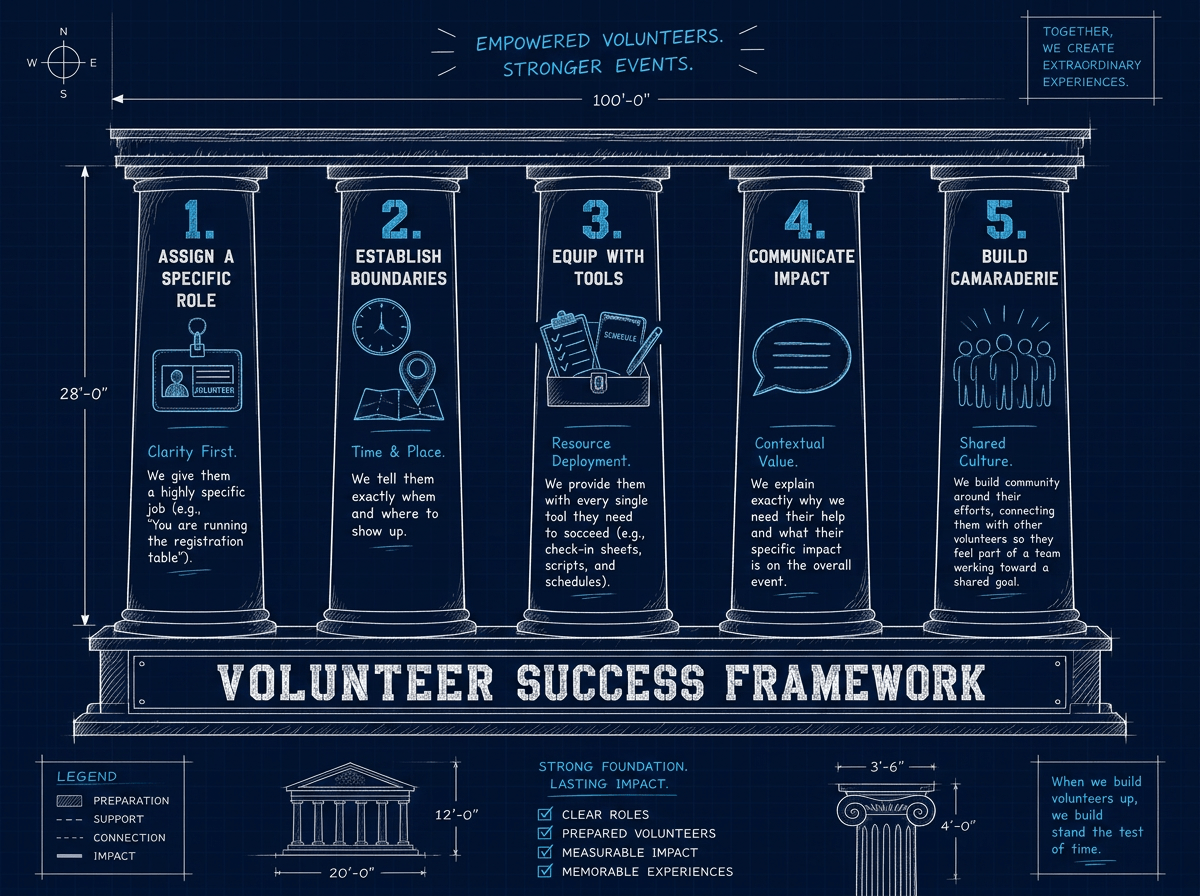
We do all of this because we know that if we don’t, the event will devolve into chaos. So why on earth don’t we do the exact same thing for our board members?
Instead, we do the complete opposite. We drop them into a boardroom and expect them to define their own roles. We ask them to “collaborate” and “volunteer for a committee,” essentially giving them the job of figuring out how they can help the Executive Director or the staff.
It makes zero sense. The board doesn’t know what the hell is going on day-in and day-out at the organization! They might have a vague idea of the daily grind—if they actually managed to read that 40-page report the staff scrambled to compile—but they are not in the trenches.
We cannot expect part-time, high-level volunteers to diagnose the operational needs of a non-profit and then magically execute on them. When we don’t manage them, we don’t get leadership; we get confusion, disengagement, and inevitably, micromanagement.
The Delicate Dance of Managing Up
Of course, managing up is a delicate dance. On paper, the board is the boss. But let’s be honest about the power dynamic: it is incredibly, painfully expensive to fire an Executive Director. Between the disruptions to funding, the hit to staff morale, and the thousands of donor dollars wasted on bloated, buggy recruiting firms just to find a replacement, boards do not want to pull that trigger unless they absolutely have to.
You have more leverage than you think—but you must use it strategically.
This shift cannot be a solo coup by the ED. It has to be a co-authored partnership. The transition begins with the ED and the Board Chair sitting down as allies. As a team, you must align on this vision first: “Our staff is running on fumes, and our board is underutilized. How do we shift from auditing the past to building the future?” Once you and your Board Chair are united, you present this structural evolution to the full board together—not as a demand from subordinates, but as a collective commitment to high-impact leadership.

Shifting the Energy: “I Did This So You Can Do That”
To fix this, we have to fundamentally shift the energy in the boardroom.
Right now, the energy flow is “Do this.” The board looks at the staff and says, “Do this research, write this report, create this committee agenda, and prove to us you are working.” This places the entire energetic and administrative burden on the staff.
We need to flip that flow to: “I did this so that you can do that.” Under this model, the power dynamic changes entirely:
- The Board says: “I built a relationship with this local business owner and secured a warm introduction (I did this) so that you can go pitch our program metrics and close the corporate partnership (so you can do that).”
- The Board says: “I advocated for our mission with three local policy officials this month and opened a door at city hall (I did this) so that you can present our impact data to the decision-makers (so you can do that).”
When board members operate under this framework, they stop acting like a boss auditing a subordinate. They start acting like an offensive line blocking for their running back. They clear the path so the staff can run the play they were actually hired to run.

Shifting from Oversight to Ownership
When board members have clear, outward-facing roles, the entire organization thrives. Research proves that non-profits with actively engaged, fundraising boards are significantly more likely to meet their annual development goals than those with passive boards.
Data from the Nonprofit Research Collaborative indicates that organizations with board members who actively participate in fundraising are noticeably more successful at reaching their development targets compared to those whose boards remain detached.⁵ Furthermore, industry benchmarks from Nonprofit Hub show that highly engaged board organizations are 17% more likely to grow their year-over-year fundraising revenue and 7% more likely to hit their overall targets.⁶ The data is clear: board passivity isn’t just an administrative annoyance; it is a financial liability.
Here is what that shift looks like in practice:
| The Traditional Board (Oversight Only) | The High-Impact Board (True Leadership) |
|---|---|
| Energy: “Do this” (creates tasks for staff) | Energy: “I did this so you can do that” (clears paths for staff) |
| Focuses inward on daily staff operations. | Focuses outward on community advocacy, public trust, and partnerships. |
| Micromanages details they aren’t close to. | Trusts the staff to run the programs they were hired to manage. |
| Treats the position as a resume-builder. | Owns their role as a vocal, active pillar of the community. |
| Waits to be asked for money or introductions. | Actively builds relationships with policy officials and donor networks. |

Flipping the Board Meeting: “What Have WE Done?”
If we want to change board behavior, we have to change the agenda. But we have to be careful here. If you turn the board meeting into a hostile interrogation of “What did you do this month?”, busy volunteers will get defensive, feel guilty, and simply stop showing up.
The “Flipped Board Meeting” should not be an inquisition. It should be a collaborative celebration and strategy session. We change the focal point from a dry, administrative review to peer-to-peer accountability and victory sharing:
- The Financial Impact: What leads have we built this quarter? Which creative fundraising avenues did we personally open up? Let’s share who got a meeting and strategize on how to help those still trying to get a foot in the door.
- The Advocacy Impact: Which local leaders, policy officials, or community partners did we educate about our work to protect our organization’s reputation and trust?
- The Personal Stake: What have we personally brought in or contributed financially to safeguard our mission?

Public Perception is Key
Let’s be honest about why this outward-facing pivot is so crucial: the staff cannot do this alone because of how the public perceives them. Everyone knows why a fundraiser is walking through the door. Whether it’s a Director of Fundraising, a Director of Development, or an Advancement Officer—and whether or not people want to admit it—they tend to be the least liked non-profit staff members in a room. There is an unspoken, collective hiss of, “Oh great, here comes that lady for my money.” Staff is too often viewed in the public eye as—to borrow a phrase my father would use—”professional beggars.” I hate saying that, but I’m here to deliver the truth.
A board member, however, operates on an entirely different plane. A trustee carries an inherent level of community prestige, and they should be using it. Period. They will not be hissed at. Because they are volunteers investing their own time and resources, they are seen in the public eye as elevated community champions, not solicitors. When a board member opens a door, it isn’t viewed as a transaction; it’s viewed as leadership.
When board members have clear, active, outward-facing responsibilities—and are coached, managed, and equipped with the tools to do them—they stop looking at the staff’s daily tasks and start looking at the horizon.

The Horizon, Not the Micro-Details
When board members are busy doing their actual jobs out in the community, the likelihood that they will turn inward and “crash out” on each other or micromanage the staff drops to near zero.
It’s time to stop treating board service like an audit committee or a spectator sport. If you’re on the board, it’s time to get on the field, own your position as a pillar of the community, and start clearing the way for the mission to grow.
I don’t just speak on this as a critic; I speak on it because I built the solution. To fix this exact disconnect, I developed The B.O.A.R.D. Method—a specialized micro-coaching program designed specifically for non-profit board members. This framework stops the passive grazing and equips trustees to leverage their unique personal strengths, supercharge community relations, and safely secure the big bucks their organizations desperately need to survive.
The era of showing up just for the catered dinner and skimming the 40-page brief is over. The sector is facing a trust crisis, our staff is burning out, and the mission cannot afford passive leadership. Let’s flip the agenda, change the behavior, and finally turn your trustees into the elevated community champions they were always meant to be.
References
- Badertscher K. The 2025 Global Philanthropy Environment Index: Canada & United States Regional Report. Indiana University Lilly Family School of Philanthropy; 2025.
- Charitable Independence Initiative. Protecting and empowering effective, independent charitable organizations. Accessed July 19, 2026.
- Abalo T, Williams J. Tax “Cliff” in 2025 Could Mean Major Change for Philanthropy and Nonprofits. Dorothy A. Johnson Center for Philanthropy; 2025.
- Faulk L. The Retreat of Influence: Exploring the Decline of Nonprofit Advocacy and Public Engagement. Independent Sector; 2023.
- Linear E, Pettit KJS. The Nonprofit Research Collaborative Special Report: Engaging Board Members in Fundraising. Urban Institute; 2012.
- Boardable. Nonprofit Board Best Practices in 2026 Guide. Accessed July 19, 2026.
- BoardSource. The Board’s Role in Fundraising: Cultivating a Collective Culture. Published September 28, 2023. Accessed July 19, 2026.