
If you are looking for a standard 9-to-5 corporate ladder where inputs equal outputs and the rules never change, close this page right now.
But if you are a creative polymath, a strategic thinker, and someone who wants to learn the psychological art of moving people and capital, welcome to the wildly misunderstood world of development. High-level fundraising is a high-stakes creative profession that demands extraordinary versatility. To survive and thrive in this space, you have to be part poet, part data scientist, part event producer, and part behavioral psychologist.
You must be capable of stepping into a room of ultra-high-net-worth billionaires and speaking their language of legacy and ROI, and then immediately pivoting to connect with a grassroots community donor contributing their last $25. You have to approach the same mission from entirely different angles—presenting mathematically airtight budgets for the analytical skeptics and weaving deeply emotional narratives for those who lead with their hearts.
If you have any reservations about money, or if you associate wealth with shame, this industry will break you. But if you can master your internal ecosystem, conquer your fears, and learn to navigate the unique squeeze of this career, you will unlock one of the most rewarding paths on the planet.
Here is what it really takes to stand in the trenches of this unique industry.

The Myth of the Forceful Fundraiser
There is a running joke among development executives about how the rest of the world views their jobs. To some, like my own dad, we are “professional beggars.” That was the exact term he used for my chosen career, mixed with a healthy dose of old-school skepticism—though he eventually came to tolerate and respect it once he saw I could make a damn good living doing it. To others, we are professional pests, interrupting their day to ask them to part with their hard-earned money.
But anyone who has stood in the trenches of development knows the truth: fundraising isn’t begging, and it isn’t coercion. It is a sophisticated, psychological blend of sales, advertising, and structural storytelling.
Take it from someone who lived it. I spent 20 years in the profession before the relentless pressure finally led to burnout. It forced me to take a major step back and pivot. However, I didn’t take a six-year break just to fix my approach to fundraising; I took that time to deeply analyze why and how my own decision-making frameworks were actively producing burnout in both my personal and professional life.
That intensive evaluation of choice and clarity ultimately led to the creation of the Truth and Order Decision-Making System. Re-engineering how I made high-stakes decisions didn’t make me walk away from the craft of fundraising; it taught me how to survive it. It taught me how to manage my environment, protect my agency, and lean into a repeatable blueprint for sustainable execution.
The Anatomy of the Ask
Here is the ultimate paradox of fundraising: You cannot force anyone to donate. You can’t twist an arm, you can’t guilt someone into a sustainable partnership, and you certainly can’t bully a donor into writing a seven-figure check. Yet, fundraisers live under permanent pressure cookers. Boards, executives, and program directors constantly demand that you bring in millions, often operating under the delusion that fundraising is a faucet you can turn on if you try hard enough.
The best development officers understand that their job is much closer to Madison Avenue than a charity tin. Much like sales and advertising, fundraising is the art of painting a picture.
But here is the critical difference that makes our work infinitely harder: We aren’t selling a tangible product. We are selling an ideology.
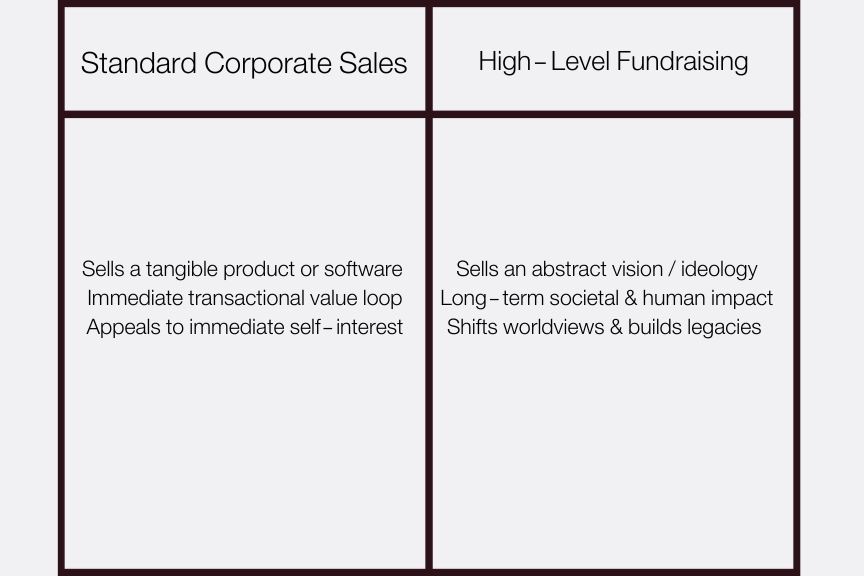
When a corporate sales rep pitches a product, the customer gets something concrete in return—a software package to streamline their business, a luxury car, or a piece of real estate. There is an immediate, self-serving loop of transactional value.
In fundraising, you are selling a vision of the world. You are asking someone to part with a very real, very precious resource—their money—in exchange for an abstract concept: justice, health, education, or legacy.
Because of this, the stakes are astronomically high. If a prospect doesn’t already care about the core tenets of your ideology, you aren’t just making a sales pitch; you are trying to shift their worldview. This requires an extraordinary amount of creative agility.
Multidimensional Storytelling for Diverse Audiences
To build a sustainable development ecosystem, you have to look at the same organizational goal and translate it into a dozen different languages for a dozen different audiences.
- For the Corporate Board or Institutional Foundation: You must approach the pitch from a mathematical and analytical angle, proving efficiency with airtight budgets, metrics, and forecasting.
- For the Community Advocate or Family Donor: You have to approach it from an emotional and humanistic angle, proving the real-world impact on individual lives.
You are simultaneously speaking to people from completely vastly different socioeconomic statuses, cultures, and mindsets. When a donor finally gives—someone who otherwise never would have acted or contributed on their own—it’s not because you forced them. It’s because your multi-dimensional storytelling was so powerful that it catalyzed a profound internal shift within them. You didn’t take their money; you woke them up to their own capacity for impact and gave them a vehicle for their own legacy.

Survival of the Thick-Skinned and the Art of Internal Coaching
To thrive in this high-stakes creative profession, you must learn to navigate an incredibly polarizing ecosystem. Dealing with external resistance requires a thick skin and a massive dose of emotional intelligence. Let’s face it: some people will despise your very presence. The moment they realize what you do for a living, their defenses go up because they view you as a threat to their bank account.
If you carry any personal shame or reservation about money, this rejection will break you. A great fundraiser understands that money is a deeply emotional, often taboo subject, and they never take a prospect’s defensiveness personally.
But dealing with the internal pressure introduces an entirely different challenge: You have to help your own leadership become fundraisers, too.
Nonprofit founders, CEOs, and program directors are brilliant at execution, but they are often terrified of the ask. They suffer from the same money taboos as the rest of the world. They want the millions raised, but they expect the development director to go out and wave a magic wand alone in a vacuum.
A truly great fundraiser recognizes that their job is as much internal coaching as it is external pitching. You have to demystify the process for your executive team. You must guide them through their own fears, teach them how to tell the story without shame, and hold their hands as you step into major donor meetings together. It is an exhausting but incredibly noble task: transforming reluctant leaders into confident champions of their own ideology.
The Biology of Bravery: The Energy, Fear, and Faith Model
Surviving the high-stakes squeeze of development requires more than just “hanging in there.” It requires an understanding of your internal ecosystem. Elite fundraising is won or lost based on a distinct biological mechanism for bravery, which breaks down into three critical pillars:
- Energy Management: In development, you are constantly absorbing the ambient anxiety of your executive board while navigating the natural defense mechanisms of reluctant donors. Energy is a finite resource. If you do not learn how to strategically protect your energy and decouple your core self-worth from the dollar amounts on your monthly tracker, burnout is a mathematical certainty.
- Conquering the Fear Response: The prospect of rejection triggers the brain’s primal survival responses. When a donor says “no,” or an executive pressures you for metrics, your body treats it as an actual threat. Conquering fear in this profession means neutralizing it—treating “no’s” not as personal failures, but as simple, objective data points.
- Leaning into Aligned Faith: This isn’t a religious concept; it is a strategic and biological one. In most corporate roles, inputs and outputs have a short, predictable leash. Fundraising is like sowing seeds where you cannot control the weather, the soil, or the timeline. Faith is the operational trust that your consistent, quiet, daily efforts—the database segmentation, the thank-you calls, the relationship building—will yield a harvest in due time, even when the horizon looks empty.
When you master that biological fear response and embrace that long-term faith, the entire scope of the work changes. You realize that if you put in consistent, aligned effort, the results will manifest.

Reaping the Rewards of a High-Stakes Creative Profession
If you can manage the anxiety, treat the “no’s” as data points, and view the internal pressure as ambient noise, this profession offers a level of creative fulfillment and reward that few other corporate jobs can match.
On any given day, a high-level fundraiser is a creative director throwing a high-profile event, a copywriter crafting a narrative that moves people to tears, a financial analyst balancing complex spreadsheets, a diplomat navigating high-net-worth individuals, and a corporate coach mentoring organizational leadership.
When it all clicks—when that alignment happens, the funds come in, and a major project comes to life—there is no better feeling. You look at a transformed community, a new hospital wing, or a protected ecosystem and think, I helped build that. I connected the capital to the vision.
It takes a truly rare breed to stand in that gap. It’s not a job for the faint of heart, but for those who can hack the pressure, protect their energy, and maintain the faith, it is one of the most powerful, exhilarating, and deeply versatile careers on the planet.